In 2023 I wrote about the Beresford sisters of Huntingdon, England, including my 3rd great-grandmother Rhoda Beresford. I have some new information to share on Rhoda.
To review, in 1850 Rhoda wed a carpenter named William Henry Ashman. They were married by license in Huntingdon. On the 9th of October, 1851, Rhoda gave birth to their daughter Eliza Mary Ashman. Fast-forward to the 1861 England Census: Rhoda was living with her Ashman in-laws in Berkshire. She said she was married (not widowed), and daughter Eliza Mary with was her, but William wasn’t there.
I still haven’t been able to track down William Henry and uncover what became of him. But I finally have confirmation that he abandoned his family.
On the 18th of November, 1851, Rhoda and Eliza Mary (just 6 weeks old) were admitted to the Huntingdon Workhouse and registered as chargeable to the parish of St John, Huntingdon. In the column “Cause of seeking relief” the official wrote “Deserted.”
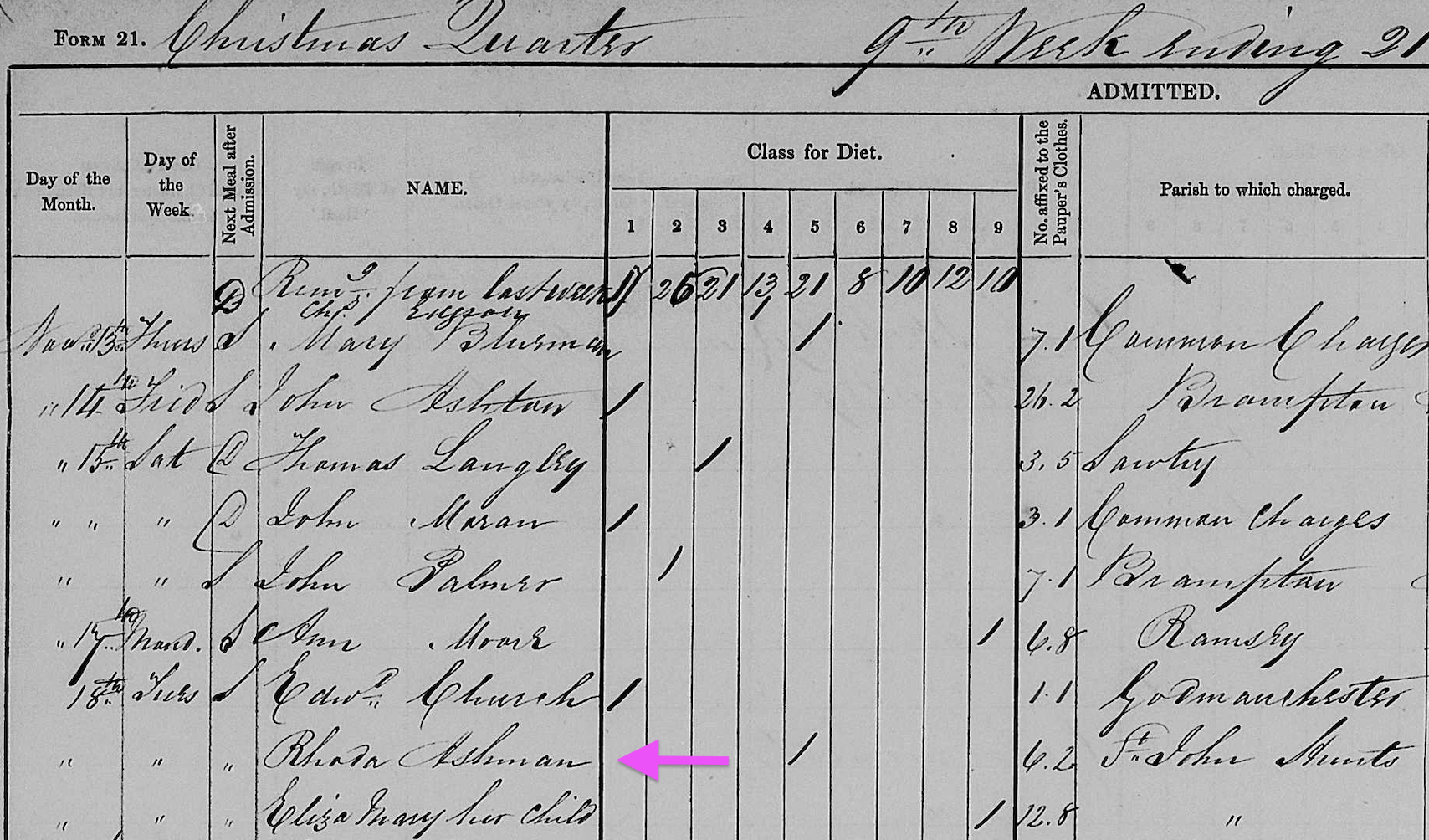
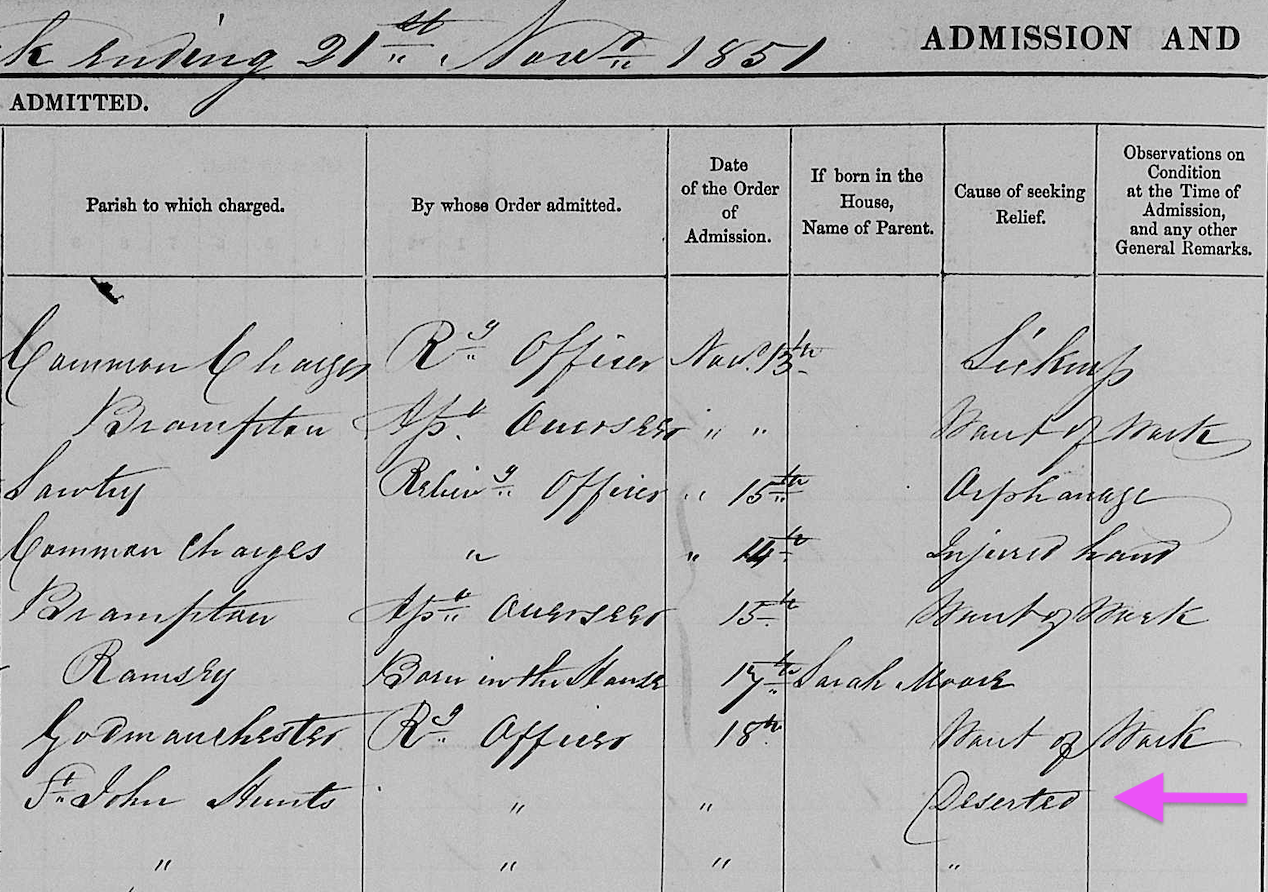
The above images are from FamilySearch Image Group Number 008868994, which covers the Admission and Discharge book of the Huntingdon Poor Law Union Workhouse for the years 1846 to 1853. The original record books are held at the Huntingdonshire Archives. Image 687 of the same image set (not pictured here) shows Rhoda and Eliza Mary’s discharge from the workhouse 4 days later. In the column “How Discharged” the official wrote “Own account.”
In 2023 I wrote that I had not found Rhoda or her children in any London workhouse records. That remains technically true. But with this discovery I found that she had not avoided the workhouse in her hometown of Huntingdon. Looking through these records, you’ll see that many other women suffered from a similar circumstance: Their husbands fled, leaving them with no way to provide for themselves or for their children. They then had to seek relief (housing, food, work, medical care, etc.) from local authorities.
What’s strange is that Rhoda went to the workhouse rather than going to her father’s house. At this time, Rhoda’s father William Beresford was living on the North End in Huntingdon with his second wife, and by all accounts they had a good standard of living. Surely William could have made some room for his daughter and granddaughter rather than have them suffer from the poor conditions at the workhouse?
Although Rhoda’s father was present at her wedding, it’s possible he did not approve of her choice of husband and he warned her that something like this might happen. Perhaps Rhoda would rather go to the workhouse than hear “I told you so!” Or maybe the problem was her stepmother - maybe they didn’t along.
I don’t know where Rhoda headed when she left the workhouse. Maybe her father took her in or maybe William Henry Ashman came crawling back begging for forgiveness before he disappeared again. (Who knows what he was up to?) But for now I’ll assume this was the only time Rhoda and Eliza Mary ended up in such an institution. By 1861 they were living with William Henry’s family. Later, Rhoda moved to London.
As with all genealogical research, I was at first thrilled to find this information confirming that Rhoda had been deserted by her husband. But it didn’t take long for me to feel frustrated that I couldn’t find more information on this chapter of her life. The workhouse register only contains a small part of the story. Maybe there are other records out there on William Henry Ashman, his movements, and his proclivities, that haven’t been scanned or indexed yet. I sure hope so. For now, I believe I can safely call William Henry a scoundrel.