Some ancestors are difficult to research, either because they didn’t leave a mark in local records or because the records are inaccessible for whatever reason. Other ancestors are mentioned frequently in records, and the local archive has done an excellent job of preserving and digitizing the materials. Thankfully, my 6th great-grandfather John Randall Sr has been easy to track throughout his life. I’ve been able to view many records about him digitally from the comfort of my own home across the pond, but I also visited the town of Huntingdon and the Huntingdonshire Archives in person in September 2022.
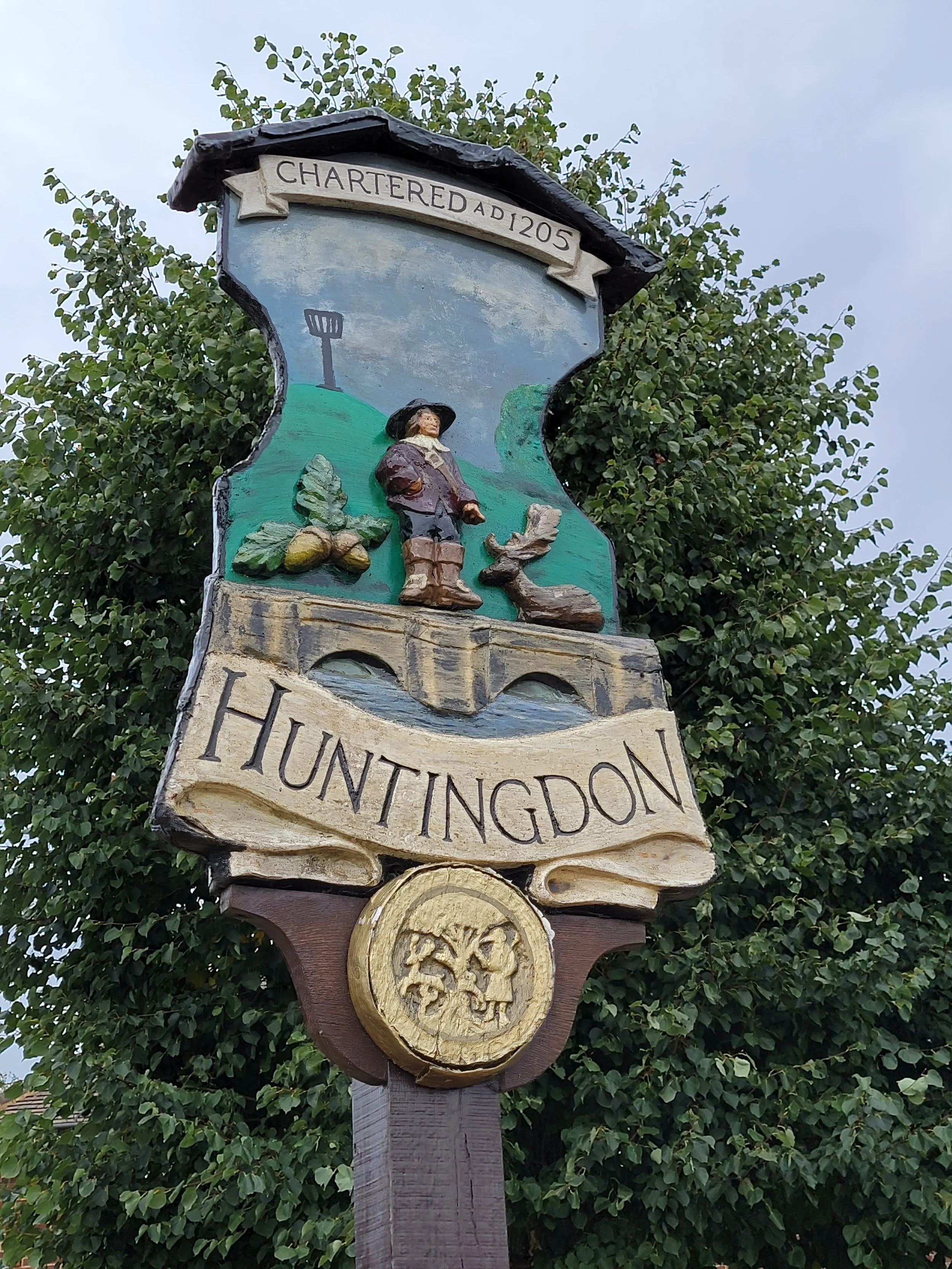
The Huntingdon town sign photographed by me in 2022
Born and bred in Bedfordshire
John Randall Sr (1728-1797) was born in Sandy, Bedfordshire, the youngest child of William Randall and Ann Keeling. At the age of 12 John was apprenticed to a master glazier named William Hankin in Potton, a town 4 miles to the east of Sandy.(1) According to Wikipedia, a glazier is “a tradesperson responsible for cutting, installing, and removing glass.” John became a successful glazier and plumber and would later take on his own apprentice.(2)
While living in Potton John met his future wife Martha Edwards (1730-1802), the daughter of John Edwards and Martha Austin. I haven’t been able to find a marriage record for John Randall and Martha Edwards (it is strangely absent from the Potton register), but they were apparently married by February 1749, when they moved to Huntingdonshire. The couple brought what was known as a settlement certificate with them to Huntingdon.(3) This certificate provided proof of their legal settlement in case they needed poor relief before they gained settlement in Huntingdon.(4)
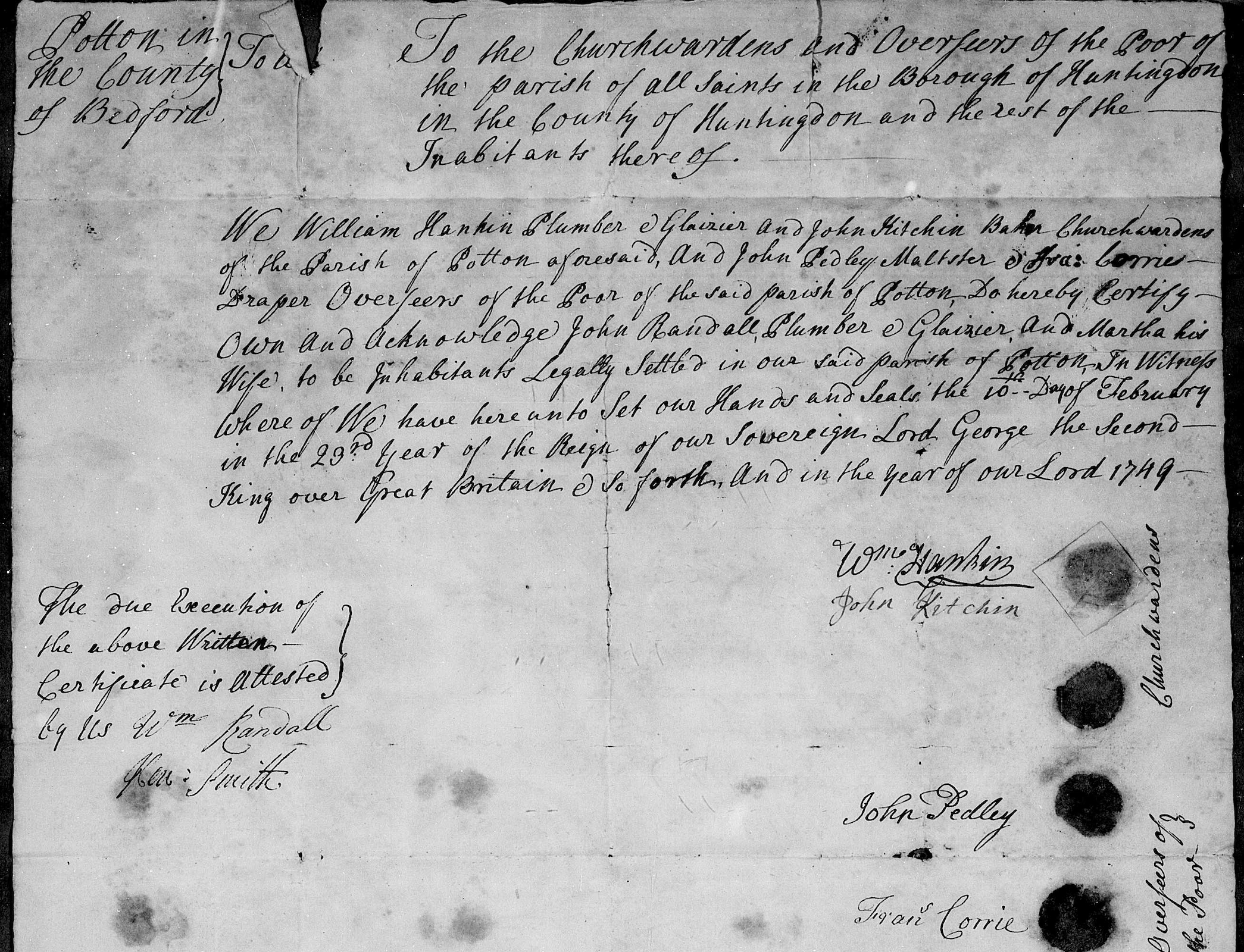
The settlement certificate that John Randall and his wife Martha brought with them from Potton to Huntingdon in 1749
John and Martha baptized 12 children in Huntingdon. Seven of these children died young, but three of their sons (John Jr, William, and Charles) and two of their daughters (Martha and Mary) lived to adulthood. I am descended from their son Charles (1757-1795), who died at age 38 and had only one son.
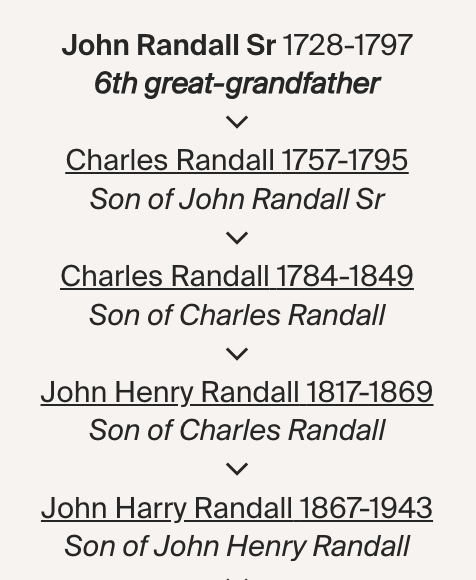
The line of descent between John Randall Sr of Huntingdon (1728-1797) and John Harry Randall of Ludlow, Massachusetts (1867-1943)
Leathering the Town Pump, Etc.
Huntingdon offered plenty of opportunities for John, including the important task of keeping the local water pump in working order. Before indoor plumbing, pumps were the main source of water in towns. On multiple occasions throughout the years, the town of Huntingdon hired John to “leather the town pump,” which probably meant replacing a leather seal or valve on the pump.
Town records also note that John supplied a new pump in Mutton Lane (1794) and installed and cleaned street lamps (1777, 1786), among many other painting and glazing jobs over the years. He also collected land taxes.(5) John’s role as a tax collector suggests he had a solid command of reading, writing, and arithmetic in addition to his mechanical skills. John also served on grand juries and leet juries for the Borough of Huntingdon. In his later years, he was regularly appointed jury foreman.(6)
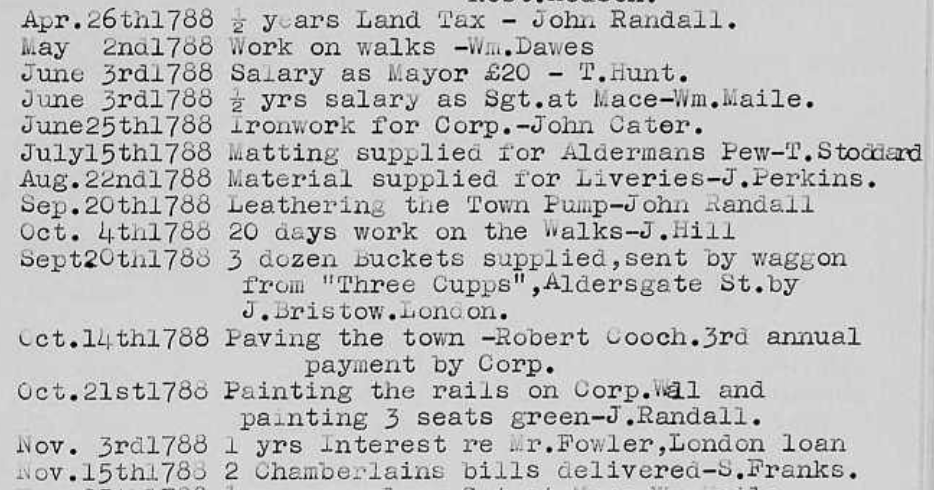
A record of some of the work performed by John Randall Sr for the Borough of Huntingdon. He is mentioned in the catalogued entries for April 26th, September 20th, and October 21st (1788).
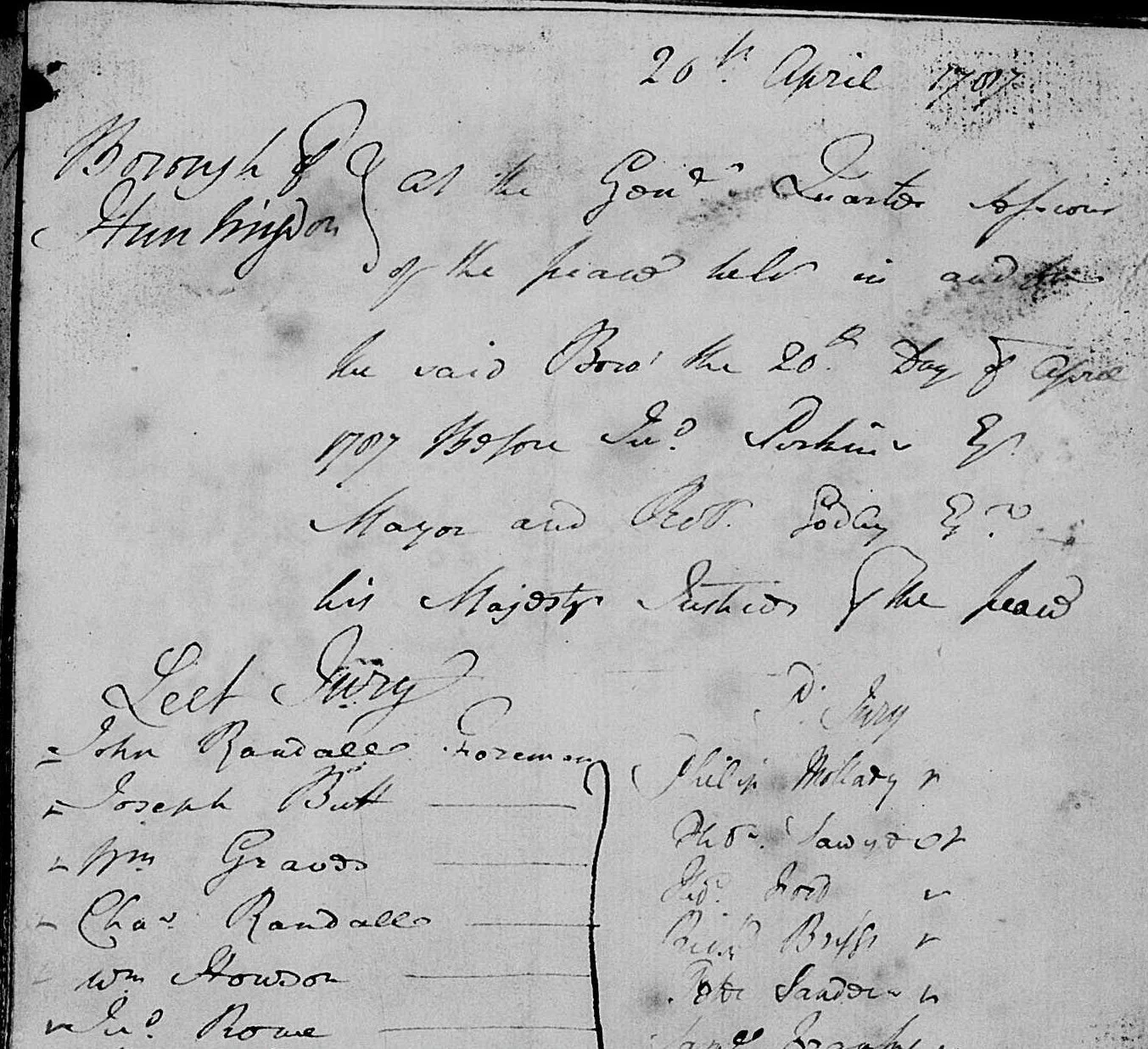
Excerpt from the minutes from the Quarter Sessions of the Peace for the Borough Of Huntington, 20th April 1787, showing John Randall as foreman of the Leet Jury. His son Charles was also on the jury.
Further searches of John’s name in digitized records (via FamilySearch full-text search) revealed that he was awarded a sizable job for the county in 1789, which was announced at the quarterly court session held on August 8th, 1789. The minutes of this session state: “It is ordered that the Hemphouse be half glazed and half wooden shutters and that the pump and glazing be done by Mr Randall.” It is interesting to note that this meeting was presided over by John Montagu, the 4th Earl of Sandwich, the statesman who supposedly invented the sandwich.(7)
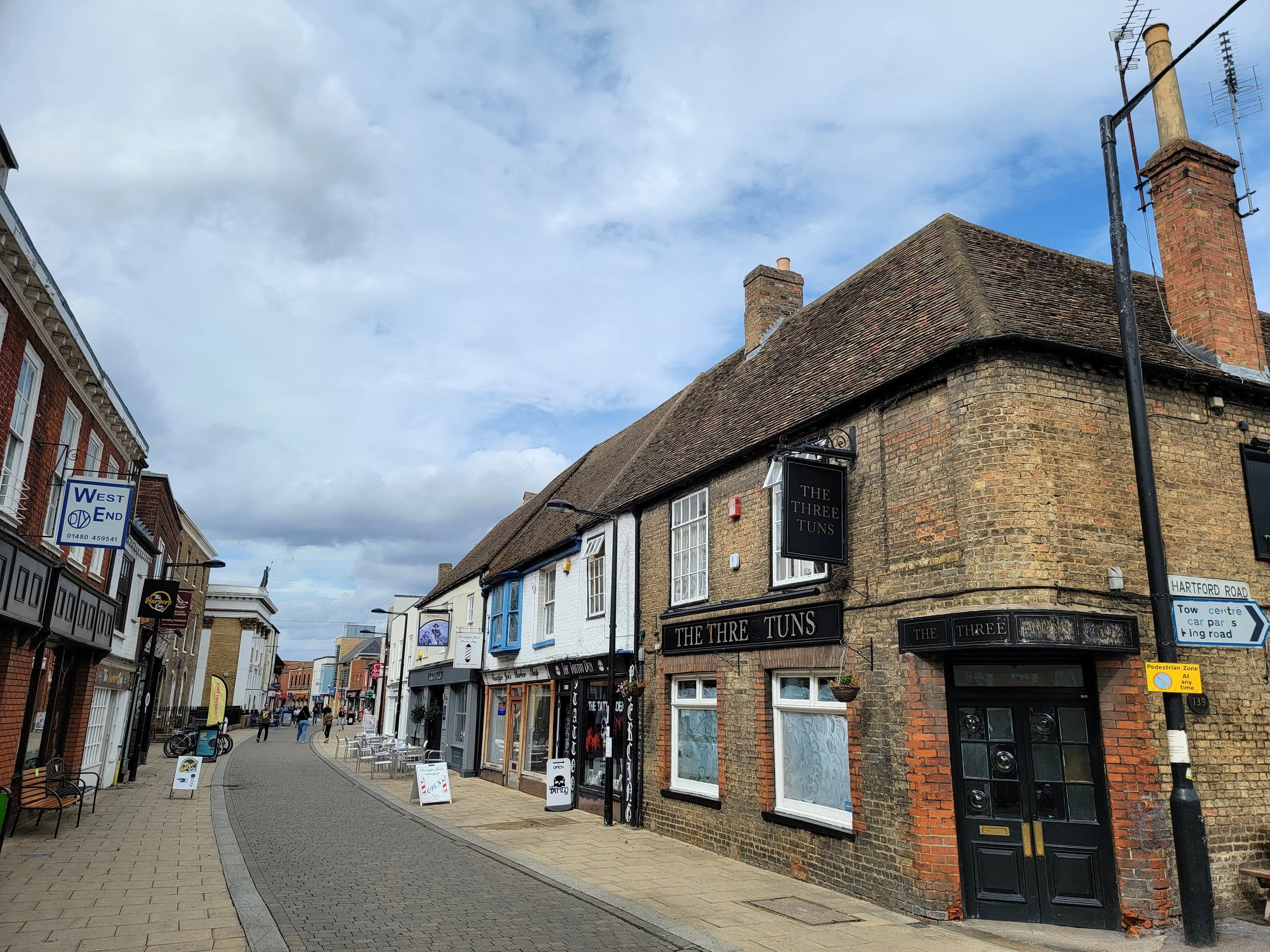
High Street in Huntingdon, photographed by me in September 2022
Mrs. Randall will carry on the business
John Randall Sr’s accomplished life came to an end in 1797. Although only 69, John outlived several of his adult children. (His sons John Jr and Charles and daughter Martha died in 1795.)
John’s will refers to his wife Martha, daughter Mary, son William, daughter-in-law Catherine, and various grandchildren. The will highlights an impressive portfolio of properties, including a dwelling house in the parish of St Benedict, Huntingdon; a house in the parish of St Mary, Huntingdon; a freehold property in Sandy, Bedfordshire; a house and orchard in Brampton; and an additional estate in Brampton.(8) (Brampton is the village that lies to the southwest of Huntingdon.) I haven’t been able to find the exact location of these properties and if any of the houses are still standing.
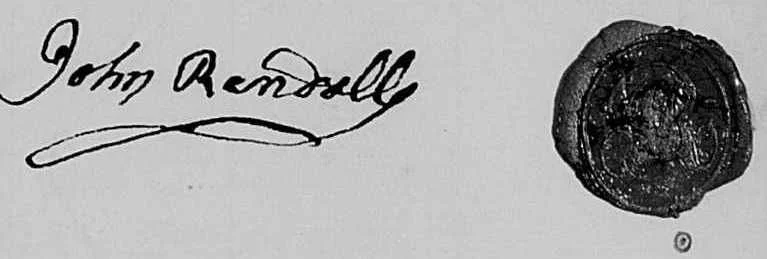
John’s signature and wax seal stamp on his will, dated 5 May 1797.
It seems there was no one in the family willing or able to take on John’s plumbing and glazing work, so that business was sold soon after his death. But surprisingly, the newspaper announcement of the sale revealed that the Randalls also operated a shop selling “earthenware, china, and glass,” and that Mrs Randall (Martha) intended to continue that business.(9)
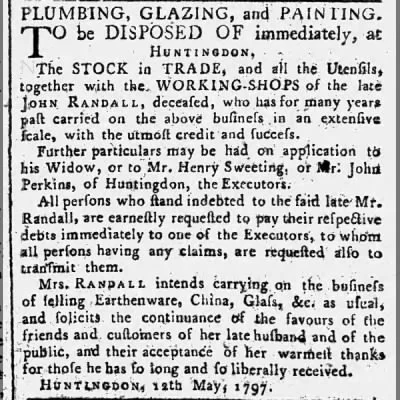
Clipping from Cambridge Chronicle and Journal, 13 May 1797
If not for this newspaper announcement, I never would have known that the family sold ceramics and housewares. I would so love to “pop in” to their shop and have a look at the merchandise. Was everything handmade by John, or did the Randalls bring in goods from outside Huntingdon? To what extent was Martha involved with the business before John’s death? Did their daughter Mary (still unmarried at this point) help out?
I don’t have the answers to those questions, but there is more to tell about Martha and her daughter Mary. My next blog post will cover these women in more detail.
References
UK, Register of Duties Paid for Apprentices' Indentures, 1710-1811 on Ancestry.com. Payment date 13 Jan 1741.
UK, Register of Duties Paid for Apprentices' Indentures, 1710-1811 on Ancestry.com. Payment date 10 Jul 1785.
Settlement certificate of John Randall and Martha his wife of Potton. (10 Feb 1749). Huntingdonshire Archives reference KHP46/13/1/89. Digitized in FamilySearch image group 008069220, Item 2.
Perkins, David. (2025, Jul 14). An introduction to settlement papers on The Blog of the Essex Record Office.
Huntingdon Record Office. (1965). Catalogue of documents belonging to the Huntingdon Corporation. Digitized in FamilySearch image group 008869027, Item 7. (I am unable to figure out the corresponding Huntingdonshire Archives reference numbers for these items)
Borough of Huntingdon. (1776-1788). Quarter sessions minute books. Digitized in FamilySearch image group 008882302, Item 3. (I am unable to figure out the corresponding Huntingdonshire Archives reference number for this item)
Huntingdonshire Quarter Sessions minute books. (1787-1790). Huntingdonshire Archives reference KHCP/2/1/3. Digitized in FamilySearch image group 008868595.
Original will of John Randall, glazier of Huntingdon. (1797). Huntingdonshire Archives reference KAH/16/2/137/22. Digitized in FamilySearch image group 008482851.
Cambridge Chronicle and Journal, 13 May 1797.