Huntingdonshire

Allpress: A Fenstanton family by Emily Randall

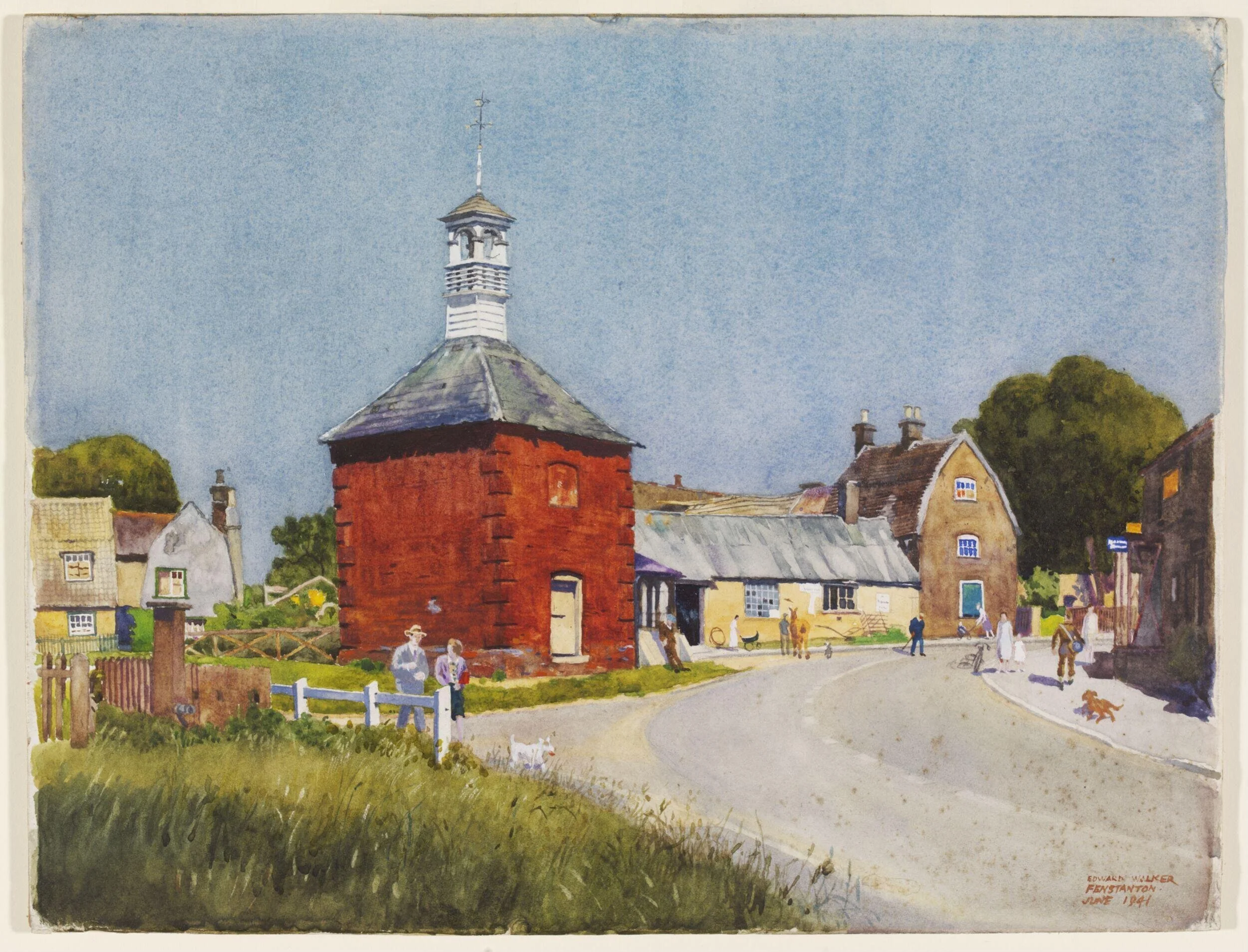
Fen Stanton: Watercolour (1941) by Edward Walker at The V&A

Fenstanton is a village in the historic county of Huntingdonshire (now in Cambridgeshire), to the south of St Ives. Its two most famous residents have been Lancelot “Capability” Brown, a renowned landscape architect and gardener, and John Howland, one of the Pilgrims who sailed on the Mayflower.(1) Fenstanton was also the site of a Roman settlement circa 100-400 AD. Here, archaeologists recently unearthed the skeleton of a man with a nail through his heel, who had been crucified as a form of punishment and death. This article from the BBC shows a facial reconstruction of the crucifixion victim. Could this be one of my ancestors?(2)

Phillip Allpress: Fenstanton farmer

My 4th great-grandmother Mary Ann Allpress (1786-1830), who married Charles Randall in 1812, was born in Fenstanton. She was the daughter of Phillip Allpress (1753-1838), a farmer, and his wife Elizabeth Taylor (1764-1843). Phillip and Elizabeth were married in August 1786, and they baptised their first child Mary Ann in December. (3, 4) I think it’s safe to say they “knew” each other before their wedding. Phillip and Elizabeth went on to baptise 11 more children in Fenstanton: Elizabeth (born 1788), Sarah (born 1789), Thomas (born 1790), John (born 1792), Phillip (born 1794), John (born 1796), Robert (born 1797), Catherine (born 1799), Rivers (born 1802), William (born 1804), and George (born 1806).(5)

In 1803, Phillip Allpress had to sell his livestock due to an inclosure act passed by Parliament the previous year.(6) These acts converted common lands and open fields into private enclosures.(7) Phillip had to part with 220 sheep, 6 cows, 4 calves, 3 horses, 1 mare, 2 pigs, and 10 hogs. I’m not sure whether this was most of his livestock or just a portion of it, but the sale gives us some insights into his farming operation. His death notice, published in 1838, suggests that he was a well-liked and well-respected man.(8)
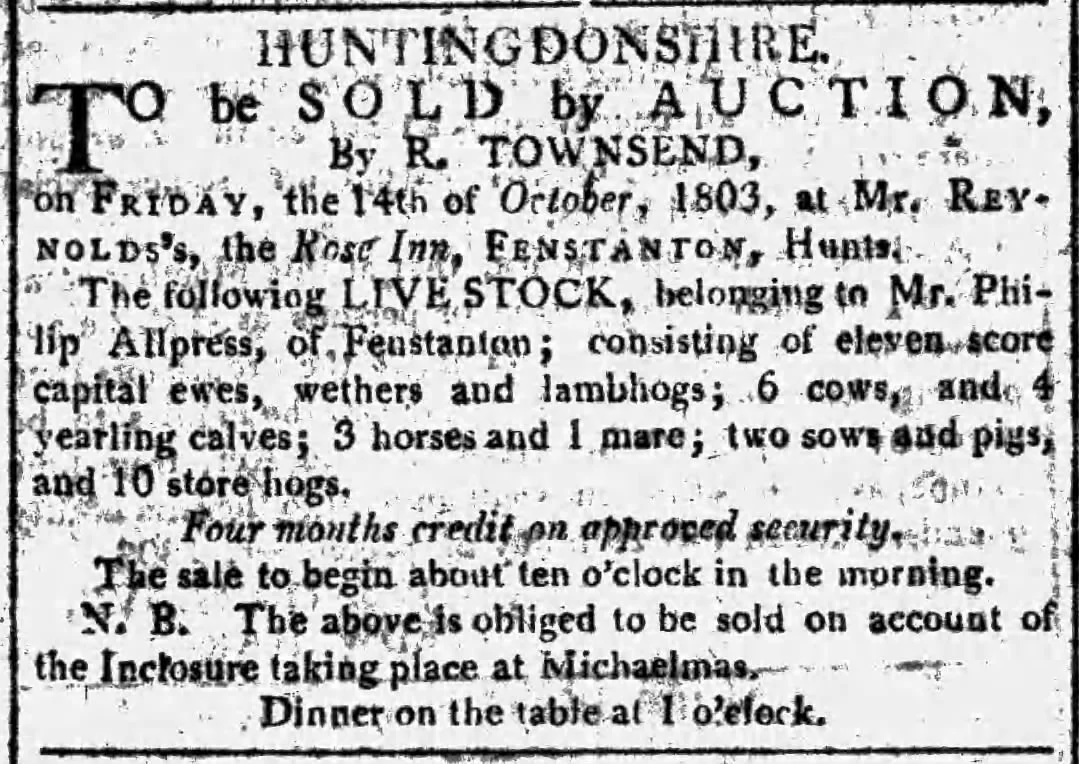
Livestock auction advertised in the Cambridge Chronicle and Journal, 8 October, 1803

Phillip’s death notice in the Huntingdon, Bedford, & Peterborough Gazette, 17 March, 1838

Tracing the Allpress surname

Phillip’s wife Elizabeth was originally from Ely, but Phillip’s family had been in Fenstanton since at least the early 1600s. I haven’t done a proper One-Name Study on his surname (I may in the future), but the Allpress name has been one of the easier names to research in my tree. All lines seem to go back to Huntingdonshire, with the earliest mentions of Allpress (sometimes spelled Alpress) recorded in Fenstanton in the early Jacobean era. According to the Bishop’s Transcripts (9), John Allpress married Joane Hutton on the 9th of February, 1605/6, in Fenstanton. I believe this couple are my 10th great-grandparents, but the further back I go the less confidence I have due to missing records. I have not been able to find a will for this John Allpress (died 1668), his first wife Joane (died 1619), or their presumed son John Allpress (died 1673). But I have found wills for various other Allpress men of Fenstanton. I believe the line leading to my ancestor Phillip Allpress (and beyond) is as follows:
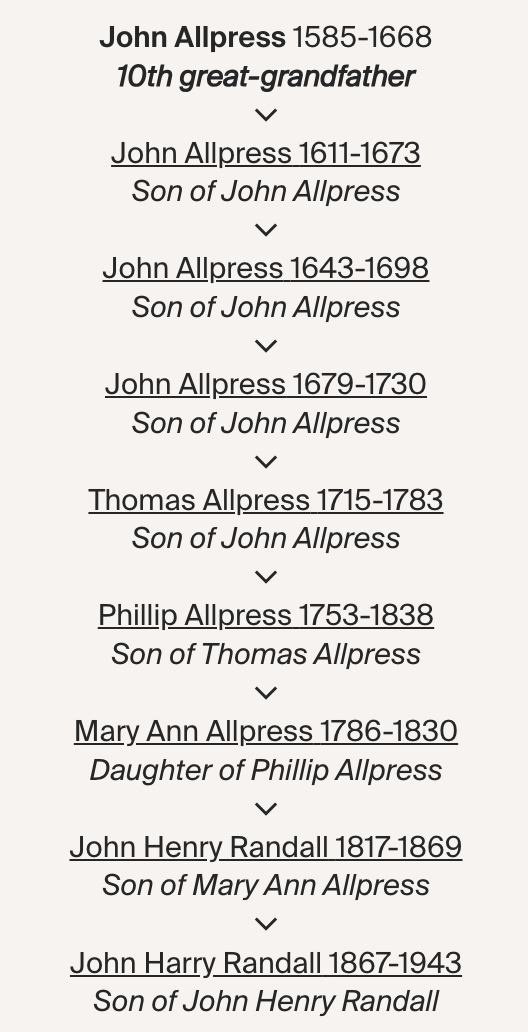
My Allpress to Randall line (Note: birth years are approximate when baptism records could not be found)

Protestation Returns

The name Allpress appears in the Protestation Returns of 1641-1642 for the parish of Fenstanton. These documents listed the adult males in England who took an oath "to live and die for the true Protestant religion" prior to the start of the English Civil War.(10) Only one-third of the lists survive. The images were previously hosted at the UK Parliamentary Archives, but those links are now dead as the collections are moving over to the UK National Archives at Kew.(11) Luckily, I downloaded the images previously and can show you some screenshots here.
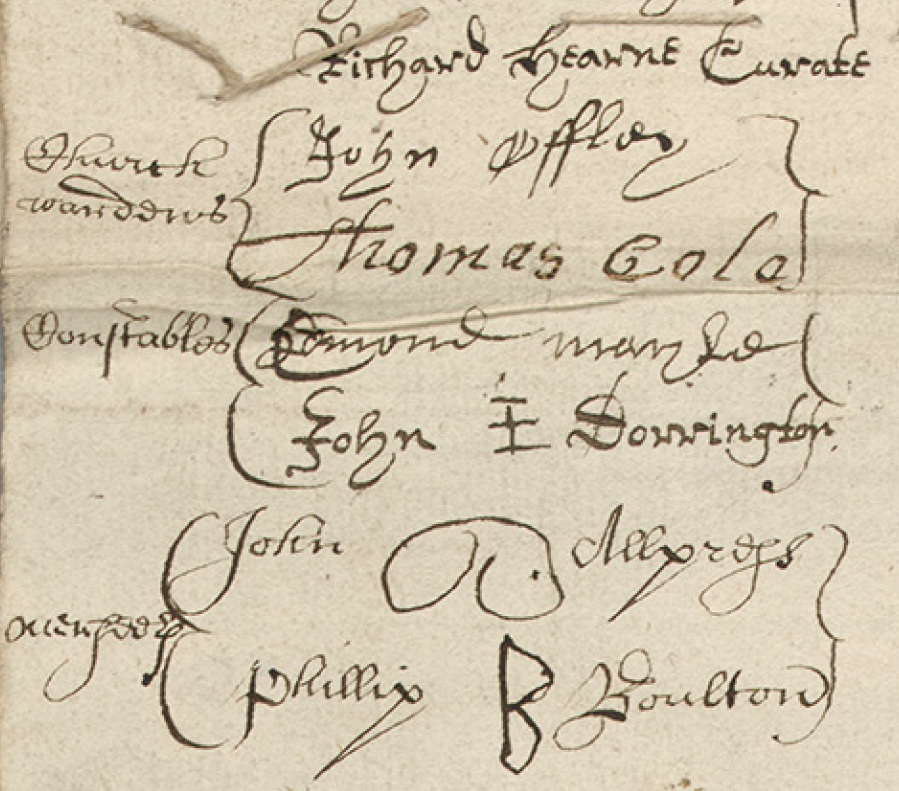
Excerpt from the Protestation Return for Huntingdonshire, Toseland Hundred, Fen Stanton (1641-1642). I think the mark of John Allpress, overseer, looks like a pair of spectacles. What do you think?

The list for Fenstanton is in great condition. The majority of the men made a mark for their name rather than signing. The list includes two men named John Allpress. Based on available parish records and wills, I think the one named as an overseer of the parish is the man who died in 1668 (my 10th great-grandfather), while the other John is the man who died in 1673 (my 9th great-grandfather).

The list also includes Henry Allpress (probably the one who died in 1651), Myles Allpress (probably the one who died in 1673), William Allpress (probably the one who died in 1697), and two men named Thomas Allpress (one of these men died in 1664; I can’t find a burial for the other Thomas).
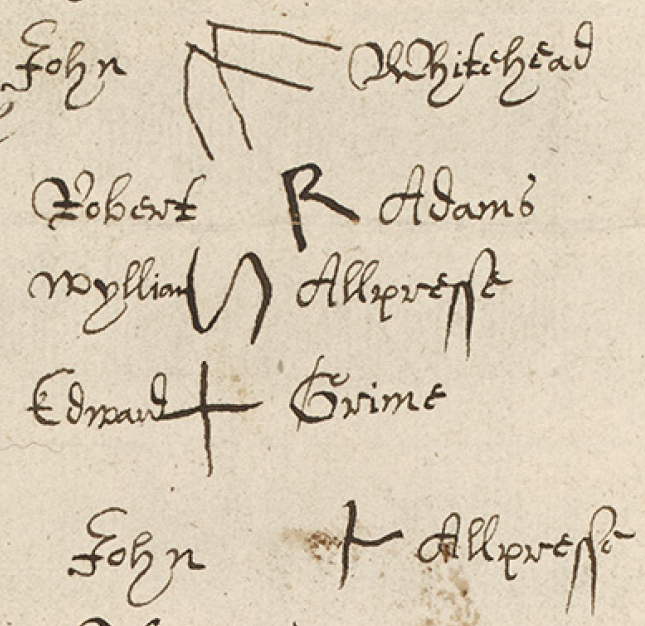
Excerpt from the Protestation Return for Huntingdonshire, Toseland Hundred, Fen Stanton (1641-1642) featuring the marks of Wylliam (William) and John Allpress

Allpress today

Nowadays, if you search on the name Allpress in Google most results will be for Allpress Espresso, a coffee company started in New Zealand by Michael Allpress. Michael is the son of the late actor Bruce Allpress, who starred in The Lord of The Rings: The Two Towers.(12) I haven’t been able to link this Allpress line to my tree (yet), but surely we are distant cousins?

Do you have the surname Allpress in your family tree? I’d love to hear from you! I have a small collection of digitized and downloaded Allpress wills that may be useful for your research.

Sources

  1. https://en.wikipedia.org/wiki/Fenstanton

  2. Prickett, K. (2024). Face of Fenstanton Roman crucifixion victim revealed. https://www.bbc.com/news/uk-england-cambridgeshire-67943596

  3. Cambridgeshire and Huntingdonshire, England, Church of England Baptisms, Marriages and Burials, 1538-1812 on Ancestry

  4. Cambridgeshire and Huntingdonshire, England, Church of England Marriages and Banns, 1754-1950 on Ancestry

  5. See Emily Randall’s Family Tree on Ancestry

  6. Cambridge Chronicle and Journal, October 8, 1803

  7. https://en.wikipedia.org/wiki/Inclosure_act

  8. Huntingdon, Bedford, & Peterborough Gazette, March 17, 1838

  9. Bishop’s Transcripts for Fenstanton, 1604-1854. FamilySearch Film #007562846, Item 2

  10. https://en.wikipedia.org/wiki/Protestation_Returns_of_1641%E2%80%931642

  11. HL/PO/JO/10/1/91/127 Protestation Return - Huntingdon - Toseland Hundred - Fen Stanton. As of February 2026 this document is awaiting a new home at the UK National Archives. See https://www.nationalarchives.gov.uk/help-with-your-research/accessing-parliaments-archive-collections/

  12. Stuff digital. (2020). https://www.stuff.co.nz/entertainment/121275446/kiwi-actor-bruce-allpress-dies-aged-89

Half a world away: The other Randall boys by Emily Randall

This is the final installment of a series on the children of Charles Randall (1784-1849) and Mary Ann Allpress (1786-1830) of Huntingdon, England. Their five youngest were all boys: Edward, Frederick, Alfred, William, and Philip. Some of these boys struggled, probably due in part to the death of their mother when they were very young. Most of the boys ended up leaving Huntingdon.

Ed and Fred Randall

Edward (1821 - ?) and Frederick (1822-1885) were two English peas in a pod. They were close in age and ended up working together as turnkeys (jailers) at the Huntingdon County Gaol (jail). In the 1851 England Census, Edward was recorded as 3rd Turnkey at the gaol while his brother Frederick was recorded as 4th Turnkey.(1)

This was not an easy job. In 1849, just a few weeks after his father died, Edward was assaulted while on duty by a prisoner named Frederick Shaw. On April 30, 1849, the Gaol Keeper wrote that Frederick Shaw “used obscene and disgusting language toward Edward Randall, the third Turnkey” and later “violently kicked Randall upon the left leg.”(2) Two and a half years later, Edward got into a physical fight with the 4th Turnkey (his own brother) and was fired. This incident was mentioned in the local newspaper (3) and in local court records (4), but details are lacking. The 1852 Epiphany (January) session minutes simply state that the visiting justices resolved that Edward “be dismissed from this office … in consequence of an assault committed by him in the Gaol on his brother Frederick Randall and that Frederick Randall be appointed Third Turnkey in his place.” This likely would have been quite embarrassing for the family.

After his dismissal, Edward decided to leave Huntingdon and sail to Australia. In October 1852 he arrived at Port Philip, near Melbourne, a journey that took over 4 months. Frederick followed a few months later.(5) The brothers settled in Maldon, Victoria, which was founded in 1854 as a Gold Rush town at the Tarrangower gold fields. I have only a few records of the Randall brothers once they arrived in Australia, as follows:

  • In 1859 Edward was fined for being drunk in Maldon.(6) I have no record of him after this date.

  • In 1876 Frederick was a plaintiff in an assault case in Maldon. Fred complained that the defendant hit him one night in his garden. The defendant claimed that Fred was very drunk and had chased his children with dogs. The case was dismissed.(6, 7) 

  • In May 1884 Frederick put his property up for sale.(8)

  • In September 1885 Frederick died in Maldon.(9) I can’t find a will or probate for him. I don’t think he had any heirs.

Sale of Mr. F. Randall's property at Nuggetty Reef, from The Tarrangower Times and Maldon Advertiser, 7 May, 1884

Alfred Randall

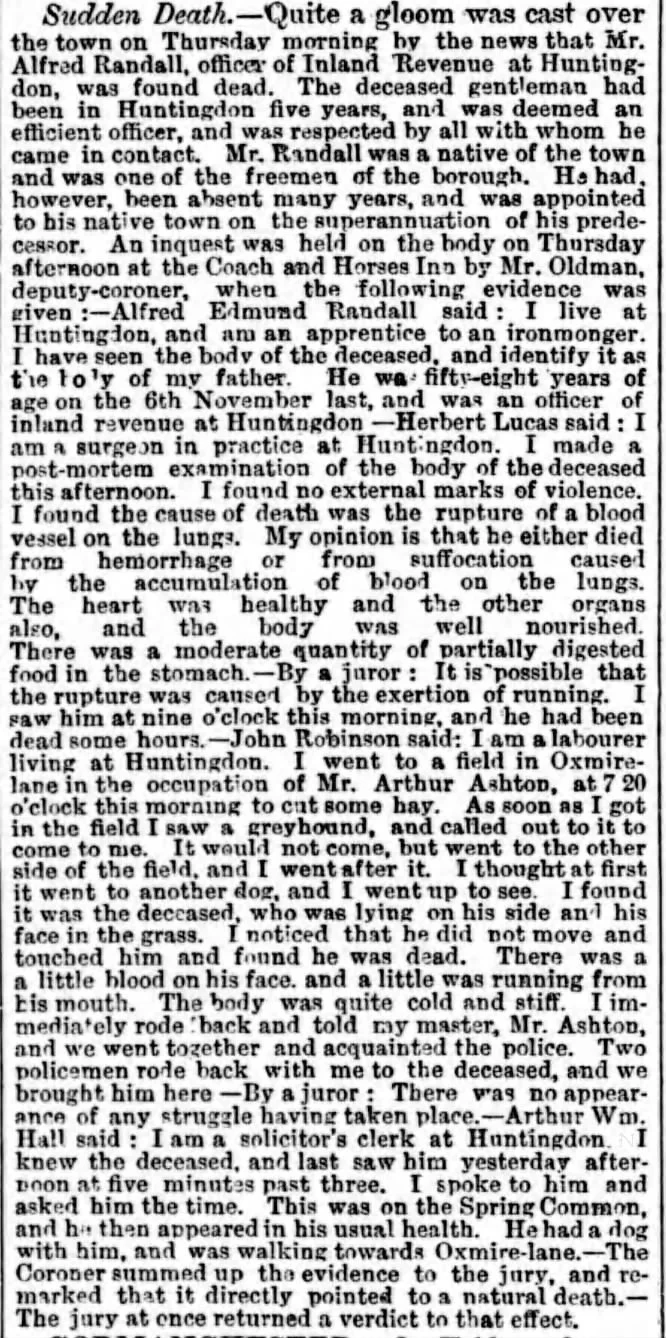
Although Alfred (1823-1882) was close in age to his brothers Edward and Frederick, he chose a different path and pursued a career as an “inland revenue” or excise officer, meaning that he worked in tax collection and tax compliance. He was married and had one son, named Alfred Edmund Randall. After living for a while in Wellington, Shropshire, Alfred returned to Huntingdon with his family, where he was well-regarded. His sudden death was covered in the local papers.(10) 

Cambridge Weekly News, 9 Sep 1882

This article describes how Alfred’s body was found in a field in Huntingdon with his loyal greyhound dog by his dog. The body was then brought to a public house, in this case The Coach & Horses Inn, where the coroner held an inquest to determine the cause of death. It may sound strange to us today to hear that a dead body was brought into a pub, but that’s how it was often done in the past before towns had an official morgue or mortuary.

William Randall

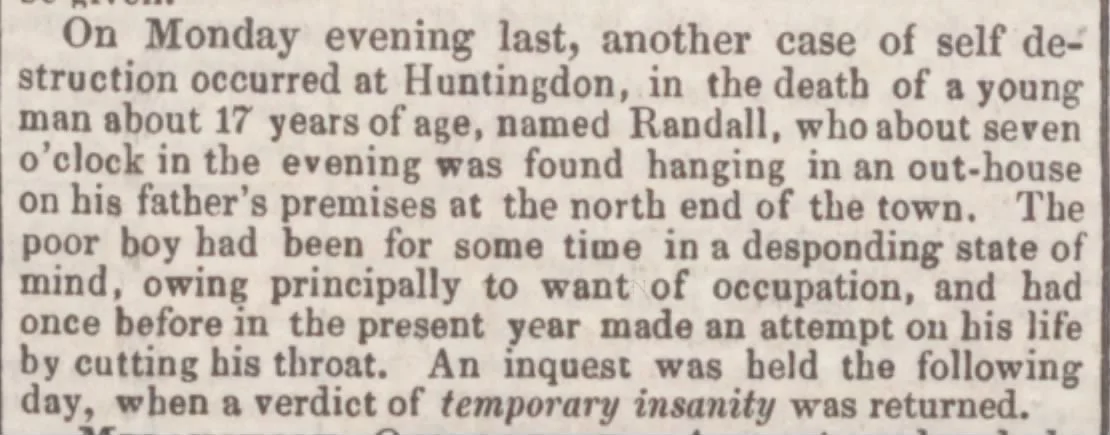
This Randall brother sadly never made it to adulthood. William (1825-1843) took his own life at the age of 17, reportedly due to “melancholy” and unemployment.(11) The cause of death was recorded as “hanging in a fit of temporary insanity.”(12) At this point in time, his father Charles was still alive and all of his siblings (except his oldest brother Charles Jr) were still residing in Huntingdon. This would have been a very dark chapter for the family.

The Cambridge Chronicle and Journal, and Huntingdonshire Gazette, 15 July 1843

Philip Allpress Randall

The youngest brother, Philip (1827-1895), was just 3 years old when his mother died, so he probably had no memories of her. But he consistently used her maiden name (Allpress) as his middle name throughout his life.

Philip was a boot and shoe maker. He and his wife Eliza had 6 children who lived to adulthood.(13) In 1881 Philip sold his properties in the North End of Huntingdon and moved to Illinois with his son Edward Stephenson Randall (1860-1947), who became a farmer and raised a family in Nokomis.(14,15) Philip’s oldest daughter, Harriet Louisa Randall (1855-1892), arrived in the US the next year.(15) Philips’ other children remained in England.

Of all the places to go in America, why did the Randalls pick Nokomis? Presumably, farm land was plentiful here. But this decision must have been influenced by Philip’s older sister Mary Ann Shelton and her sons, who had settled in Nokomis by 1880. This shows that siblings Philip and Mary Ann were in contact even though they had not seen each other for many years - a heartwarming thought considering all the difficulties the family had been through. 

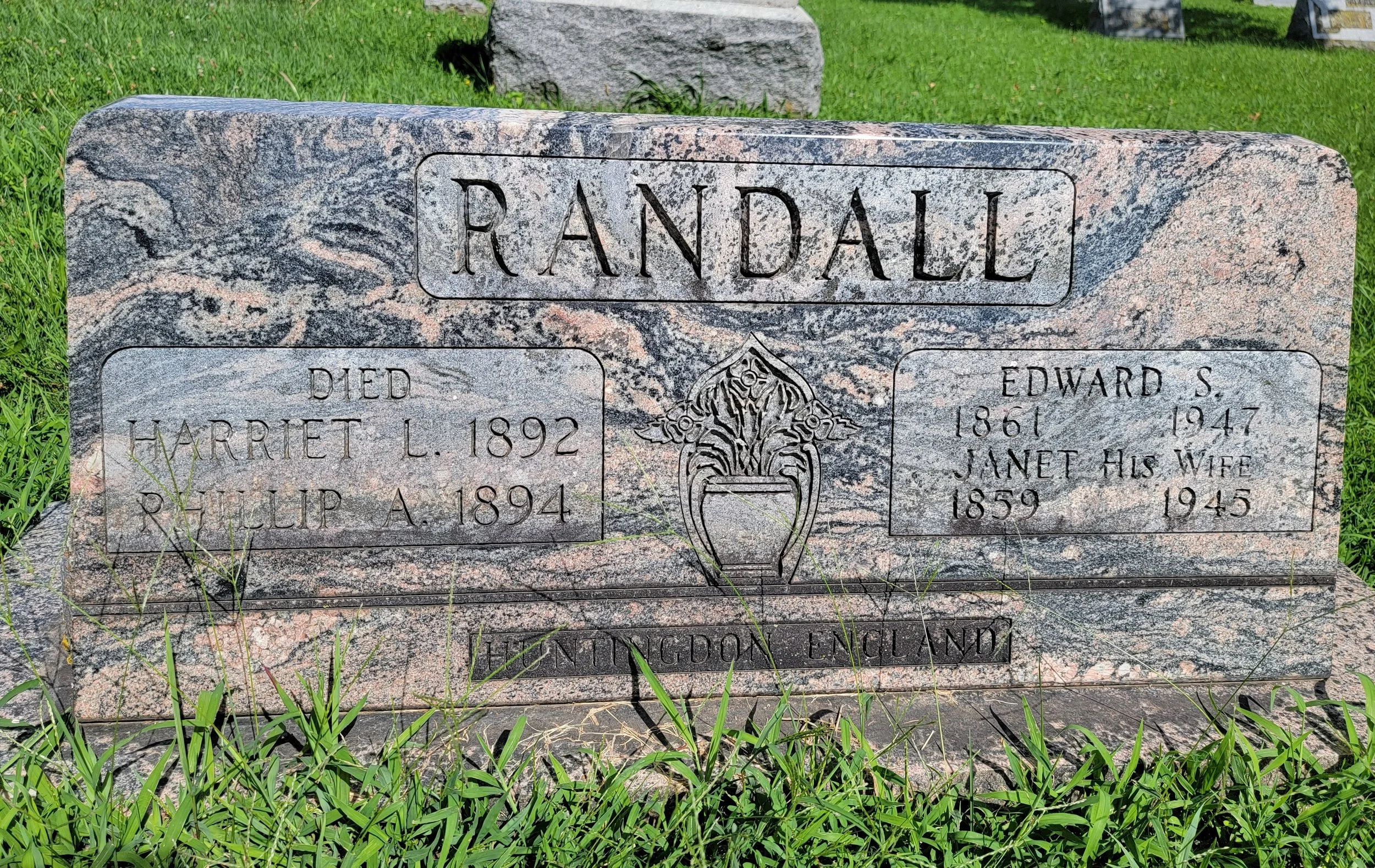
The Randalls have a plot in Nokomis Cemetery with a very handsome headstone. Etched into the bottom of the stone are the words “Huntingdon, England” as a reminder to later generations of the family’s origins.

The Randall family plot in Nokomis Cemetery, Nokomis, IL, photographed in 2022

I paid a visit to the gravesite in 2022 on one of my regular Belleville to Chicago drives. If you are descended from Philip A Randall drop me a line! I have much more Randall information to share.

Sources

  1. 1851 England Census for Great Stukeley, Huntingdonshire.

  2. Huntingdon County Gaol Keepers Journal (1847-1851). FamilySearch Image Group Number: 008179742, images 51-53 of 279.

  3. Cambridge Weekly News, 10 Jan, 1852, pg 4.

  4. Quarter Session Records of Huntingdon, Minute Books (1849-1863). FamilySearch Image Group Number: 008868600, image 165 of 224.

  5. Victoria, Australia, Assisted and Unassisted Passenger Lists, 1839–1923.

  6. Victoria, Australia, Petty Session Records, 1854-1922.

  7. The Tarrangower Times and Maldon Advertiser, 27 May, 1876, pg 2.

  8. The Tarrangower Times and Maldon Advertiser, 7 May, 1884, pg 3.

  9. Australia Death Index, 1787-1985.

  10. Cambridge Weekly News, 9 Sep 1882, pg 7.

  11. The Cambridge Chronicle and Journal, and Huntingdonshire Gazette. 15 July, 1843, pg 3.

  12. General Register Office. Death certificate for William Randall, 10 July, 1843

  13. 1871 England Census for St John’s Huntingdon, Huntingdonshire.

  14. 1920 U.S. Federal Census for Nokomis Township, Montgomery County, Illinois.

  15. New York Passenger Lists, 1820-1957.